
AI Business Process Automation for Marketing Teams
Start AI business process automation with one expensive, repeatable marketing workflow whose outcome can be recorded in CRM or analytics. Establish a baseline, connect only the required data and approvals, test the scenario before launch, then review quality and business signals weekly. Scale only when the pilot produces reliable, traceable results.
Key takeaways
- —Choose a first workflow based on repeatability, cost of delay, available data, accountable ownership and a measurable outcome.
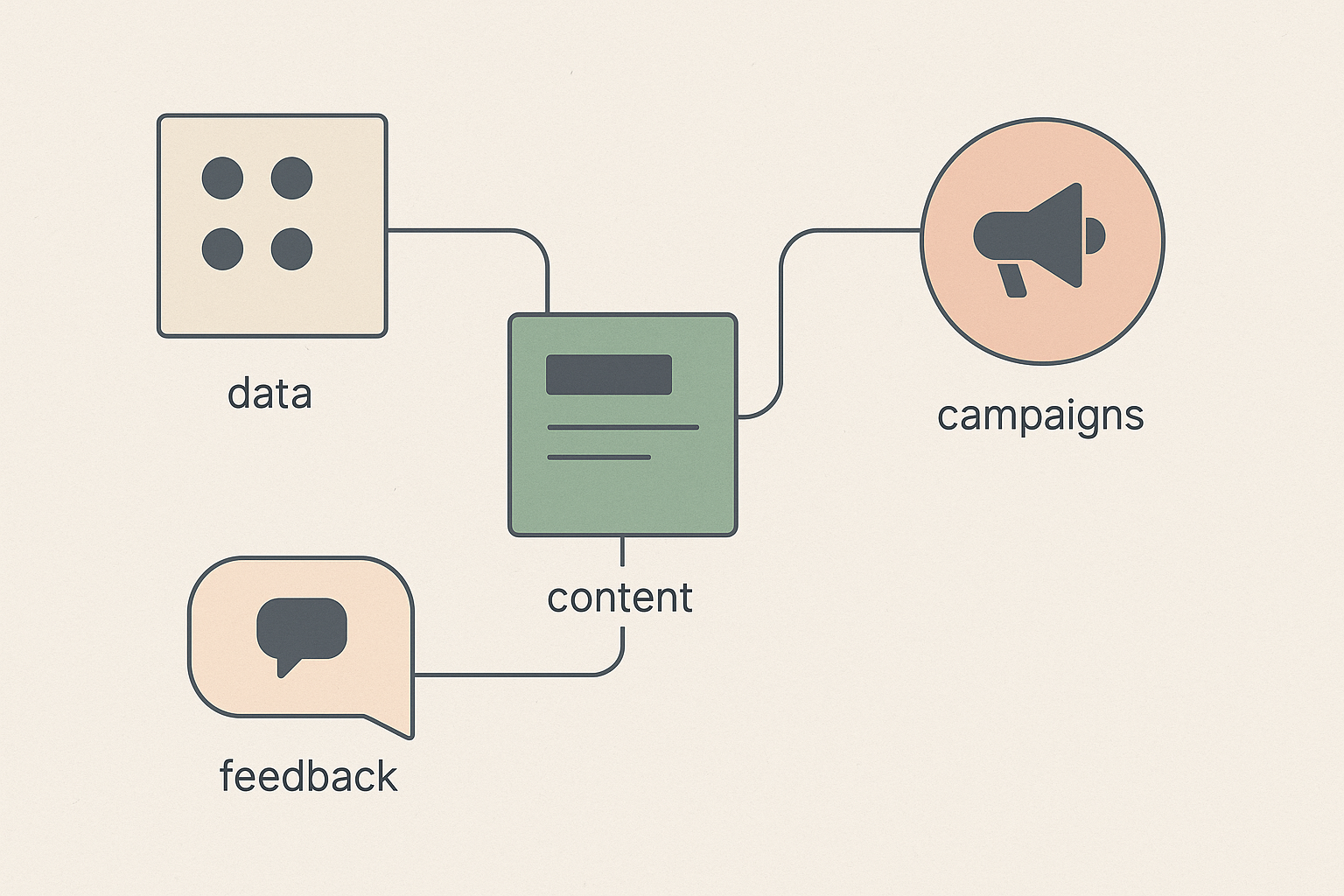
- —Treat AI automation as a connected operating system for data, content, campaigns, leads and measurement rather than a collection of generators.
- —Use primary conversion goals for optimisation carefully and keep diagnostic signals separate from the main decision rule.
- —Require human approval for material claims, sensitive communications, unusual spend changes and exceptions.
- —Expand only after the pilot has a documented baseline, recorded outcomes and a repeatable review process.
What AI business process automation means in marketing
AI business process automation is not simply asking a model to write copy or summarise a report. It is a managed workflow that moves approved inputs through decisions, production, activation and measurement, while preserving records of what happened. For a marketing leader, the useful unit is a process with an owner and a business outcome, not an isolated AI tool.[1] [3]
A connected system may bring together audience and CRM data, content briefs, campaign settings, lead routing and performance feedback. The connection matters because an apparently polished asset has little operational value if its source, approval status, campaign use and resulting lead quality cannot be traced. NIST frames governance, documentation and evaluation as continuing activities rather than a one time model choice.[3] [5] [1]
The aim is to reduce avoidable manual handoffs while keeping judgement where the cost of an error is high. Automation can prepare variants, classify requests, enrich records or flag anomalies; people should still set commercial priorities, approve exceptions and interpret ambiguous results. This split gives the team a way to test whether the workflow improves execution without assuming that automation eliminates the need for specialist expertise.[1] [5]
Choose the first process before choosing the tool
Start with a workflow that recurs often enough to learn from, consumes meaningful coordination time and has a visible finish line. Examples can include turning approved briefs into channel ready drafts, routing qualified inbound leads or reconciling campaign outcomes with CRM stages. Avoid beginning with a broad promise such as automating marketing, because it offers no stable boundary for data, ownership or evaluation.[3] [1]
Assess each candidate process against five questions: is it repeatable, what is the cost of delay, are the necessary inputs available, who owns the decision and which recorded outcome will indicate progress? A process with incomplete source data may still be a research candidate, but it is a weak production pilot. Clear conversion definitions are especially important where advertising systems will optimise toward a selected outcome.[1] [3] [5]
Write a short process card before configuring anything: trigger, inputs, actions, human approval points, output, escalation route and baseline metric. An AI automation diagnostic can help a leadership team compare a small set of applicable scenarios and identify where data or operating rules are missing. This discipline turns an attractive idea into a testable operational hypothesis.[1] [3]
Map the connected marketing system
Use five connected contours to map the target system: data, content, campaigns, leads and analytics. Data supplies approved customer and performance signals; content converts briefs into governed materials; campaigns activate approved work; lead operations capture follow up; analytics returns outcomes to the team. Mapping these contours exposes gaps that a standalone generator would otherwise conceal.[2] [3] [1]
The operating model should define how CRM, advertising accounts, analytics and content operations exchange only the fields needed for the scenario. AI marketing platform services are most useful when they are evaluated as part of this wider flow rather than as an additional disconnected dashboard. Keep a named system of record for each critical field, especially lifecycle stage, consent status, conversion value and approval status.[1] [2] [3]
Reserve human decisions for brand claims, regulated or sensitive messages, budget exceptions, unusual targeting changes and final interpretation of commercial performance. Let automation handle structured preparation, checks against defined rules and routine handoffs where the output can be reviewed. This boundary should be explicit in the workflow, because a person informally watching a system is not the same as a defined control.[5] [3] [1] [6]
Run a bounded implementation pilot
Begin with a diagnostic of the current process, including its trigger, manual steps, delays, error patterns and source systems. Capture a baseline before changing the workflow, such as completion time, share of records processed correctly or share of campaign actions recorded with outcomes. The baseline should describe the same population that the pilot will serve, not a convenient historical average.[1] [3]
Next, grant minimum necessary access, document the data fields and build one scenario with clear stop conditions. A pilot delivery approach should include a test environment or limited audience where feasible, sample based output review and a rollback path. Test routine cases, missing inputs, conflicting instructions and escalation cases before allowing the scenario to affect live communications or optimisation decisions.[1] [2]
After launch, hold a weekly review led by the process owner. Compare recorded results with the baseline, inspect exceptions and corrections, and decide whether to adjust inputs, rules, approvals or measurement before increasing volume. A pilot is ready for broader use only when the team can explain the result, reproduce the operating steps and handle foreseeable failures without relying on an individual operator.[1] [3]
- Document one repeatable process with an accountable owner and baseline outcome
- Define the trigger inputs approvals escalation rules and recorded output
- Connect only required CRM advertising analytics and content data fields
- Test normal incomplete and exception cases with human review
- Launch to a limited scope and inspect results every week
- Scale only after quality traceability and business outcome are documented [1] [3] [2]

Measure outcomes rather than activity
Define the primary conversion as the customer action most closely connected to the pilot objective, then define secondary actions that help diagnose the path. Google Ads describes a conversion action as a customer activity valuable to the business, and its primary or secondary setting affects how it is used. Do not allow a convenient but weak signal to become the workflow’s main success criterion merely because it is plentiful.[3] [5]
Connect advertising and CRM data where the commercial outcome occurs after the initial click or form. Enhanced Conversions uses hashed first party data supplied by users on the conversion page to improve online conversion measurement, subject to suitable implementation and data practices. For offline outcomes, define the matching logic, required fields, upload or transfer cadence and treatment of duplicates before interpreting optimisation performance.[2] [3]
Separate observed conversions from modelled conversions in reporting and discussion. Modelling can help account for measurement gaps, but it is not direct evidence that every attributed customer action occurred as recorded in a CRM. Review both the advertising platform view and the downstream business record, then use experiments or controlled comparisons where practical to test whether the automated scenario contributes meaningful incremental value.[4] [3]
Put governance and content controls into the workflow
Assign a business owner for the outcome, an operational owner for the workflow and an approver for high impact exceptions. Maintain a simple decision log that records material rule changes, approved prompts or templates, data sources, incidents and corrective actions. NIST highlights governance, content provenance, pre deployment testing and incident disclosure as areas that deserve deliberate attention in generative AI use.[1]
Access controls should follow the scenario rather than convenience: limit credentials, separate environments where possible and periodically review who can change rules or retrieve data. Security and data practices should cover approved data handling, model access, vendor connections and the handover of deliverables to the operating team. This makes accountability visible when an automated action needs investigation or reversal.[1] [2]
Require review of materials that make product claims, refer to customers, use likenesses or appear as endorsements. Do not manufacture reviews, testimonials or social proof, and disclose relevant relationships where endorsement rules require it. The FTC guidance addresses endorsements, influencers and reviews, so teams should treat generated promotional material as a compliance workflow as well as a creative output.[6] [1]
Recognise the failure modes early
The most common failure is automating an unstable process. If teams disagree on lead stages, campaign naming, approval authority or what counts as a completed action, automation can distribute inconsistency faster. Pause the build and resolve the operating definition first; otherwise the apparent efficiency gain may be offset by reconciliation work and unreliable reporting.[1] [3]
A second failure is optimising toward a weak or incomplete conversion signal. Automated bidding is designed to optimise toward conversions or conversion value, so the selected goals and their data quality influence the system’s behaviour. Missing offline outcomes, duplicate events or a poorly chosen primary action can produce attractive platform indicators that do not align with qualified pipeline or revenue decisions.[5] [3] [2]
A third failure is treating generated content as automatically accurate, original in commercial effect or suitable for publication. Outputs may be irrelevant, unsupported, misleading or inconsistent with approval requirements, while undisclosed integrations can create operational and data risks. Use review queues, source checks, exception logs and clear escalation rules rather than assuming that a well formed response is a safe business asset.[6] [1]
Scale only after the pilot is understood
Set a limited pilot scope: one process, one owner, a defined user or audience segment, required systems and a review cadence. Success is the share of the selected process completed through the agreed AI scenario with a recorded result in CRM or analytics, compared with the documented baseline. Include quality checks and exception rates so that higher throughput is not mistaken for a better operational outcome.[3] [1]
At the end of the pilot, review business outcome, quality, operator effort, data completeness, incidents and approval delays together. Scale to another segment or channel only if the existing scenario has a stable owner, documented controls and a result the team can trace through its systems. Replicate the method, not blindly the configuration, because each channel may have different conversion and content risks.[1] [4] [3]
A marketing platform may consolidate content, campaigns, targeting and analytics into one system, as described in the Miracle.Cool case. That example is useful as a model of connected scope, but it should not substitute for validation in a different company, data environment or commercial model. Treat broader rollout as a sequence of evidence based decisions rather than a promise of a universal outcome.[1] [3]
Frequently asked questions
What is the best first marketing process to automate with AI
Choose a repeatable process with a known owner available inputs and a recorded business outcome. A bounded workflow such as lead routing or approved content preparation is easier to test than a broad mandate to automate marketing.[1] [3]
How should a team measure an AI automation pilot
Record a baseline for the same process population, define a primary outcome and keep diagnostic measures separate. Compare recorded CRM or analytics outcomes with the baseline while reviewing quality exceptions and data completeness.[3] [2] [4] [5]
Can automated bidding be used as the main measurement system
It can optimise toward selected conversions or conversion value, but it should be checked against downstream business records. The choice and status of conversion actions affect optimisation, while modelled conversions should not be confused with directly observed CRM outcomes.[1] [6] [5] [3] [4] [2]
Which content controls are necessary for generated marketing materials
Use named approval owners for sensitive claims endorsements and customer references, keep records of important decisions and establish escalation paths. Avoid synthetic reviews or testimonials and consider applicable disclosure requirements for endorsements and influencer relationships.[1] [3] [6]
Sources and evidence
- 1.Artificial Intelligence Risk Management Framework: Generative Artificial Intelligence Profile — NIST primary guidance used for governance content provenance pre deployment testing incident handling and human oversight principles.
- 2.Enhanced Conversions Best Practices — Google Ads documentation used for the description of hashed first party data and enhanced conversion measurement practices.
- 3.About conversion measurement — Google Ads documentation used for conversion actions primary and secondary settings and measurement design.
- 4.How conversion modeling works — Google Ads documentation used for the distinction between modelled conversion reporting and directly observed outcomes.
- 5.Your guide to Smart Bidding — Google Ads documentation used for the description of automated bidding optimisation toward conversions or conversion value.
- 6.Endorsements, Influencers, and Reviews — FTC guidance used for controls around endorsements influencers reviews and related disclosures.