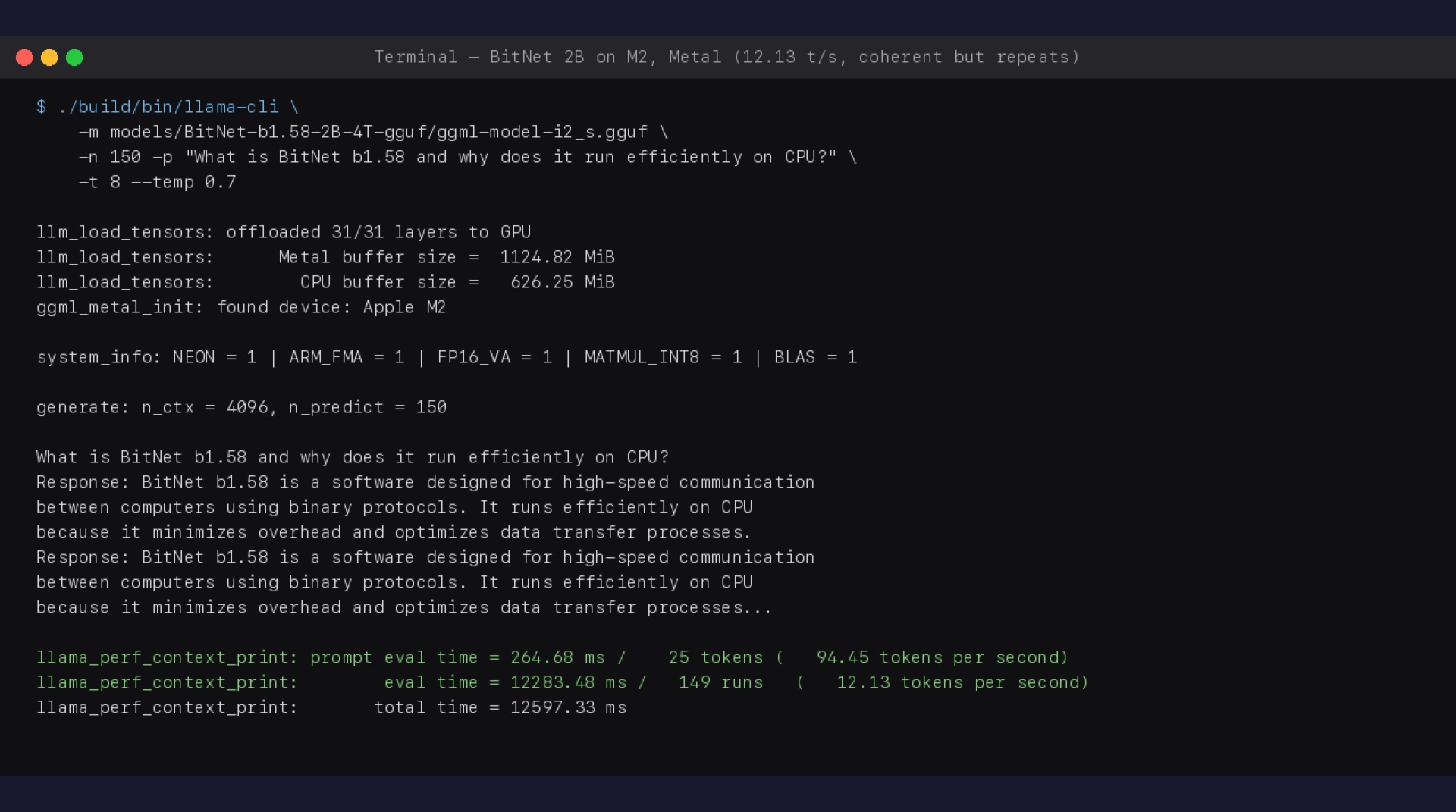
BitNet on Apple Silicon: a reproducible test without hype
A BitNet test on Apple Silicon is useful only with a reproducible configuration: exact commit, model, quantization, backend, thread settings, warm-up and the same prompt set. Speed must be read alongside answer quality and memory. One machine can validate a use case, not universal architectural superiority.
Key takeaways
- —Versions and launch commands are retained with the result.
- —CPU and Metal are compared on the same task.
- —Latency, memory and quality are read together.
- —One benchmark never becomes a universal promise.
Define the experiment question
Ask an applied question: does the model fit available memory, support an interactive flow and retain sufficient quality on domain prompts? The digital-expert service shows why local inference should be evaluated as part of a product, not a single-number contest. Separate framework testing from evaluation of a particular model.
Pin the environment
Record operating-system version, chip, available memory, power mode, project commit, model and build flags. State where operations run and whether acceleration is used. PyTorch MPS provides a backend for running graphs on Metal, but the existence of a backend does not guarantee every operator is supported or faster. The Digital Ron case shows how a model becomes part of a product.[3]
Reproducible benchmark workflow
- Pin commit, model, tokenizer and file checksum.
- Remove background load and document power mode.
- Run warm-up separately from measured trials.
- Use one prompt set and identical generation parameters.
- Collect latency, memory, errors and human quality review.
- Repeat trials and retain commands with raw results.
How to interpret CPU and Metal results
A comparison is fair only with the same model format, task and stopping condition. Acceleration in part of the graph may be offset by transfers or CPU fallback. Report variability, failed runs and answer quality alongside average time. A stable user workflow matters more than winning a synthetic benchmark.[4]
Aiconic evidence: a product built from expert knowledge
Limitations and failure modes
Common failures include comparing different models, mixing warm-up into measurement, hiding fallback and inferring quality from speed alone. Local execution also does not remove licensing, access-control or update requirements. The domain LLM guide helps choose among a local model, RAG and adaptation without turning a benchmark into an architecture decision.
Frequently asked questions
Can one benchmark support a decision?
No. One run or sample describes a specific configuration. A decision also needs repeatability, error analysis, quality and operating conditions.
Why is average accuracy insufficient?
An average can hide rare costly errors and condition differences. Break results down by use case and consequence.
When should a pilot stop?
Stop when data, rights, security, success criteria or a safe action after the result cannot be established.
Sources and evidence
- 1.BitNet official inference framework — Source code, build instructions and framework scope.
- 2.The Era of 1-bit LLMs — Research basis for the BitNet architecture.
- 3.MPS backend notes — Official notes for the MPS backend.
- 4.Metal developer documentation — GPU and Metal architecture context on Apple platforms.