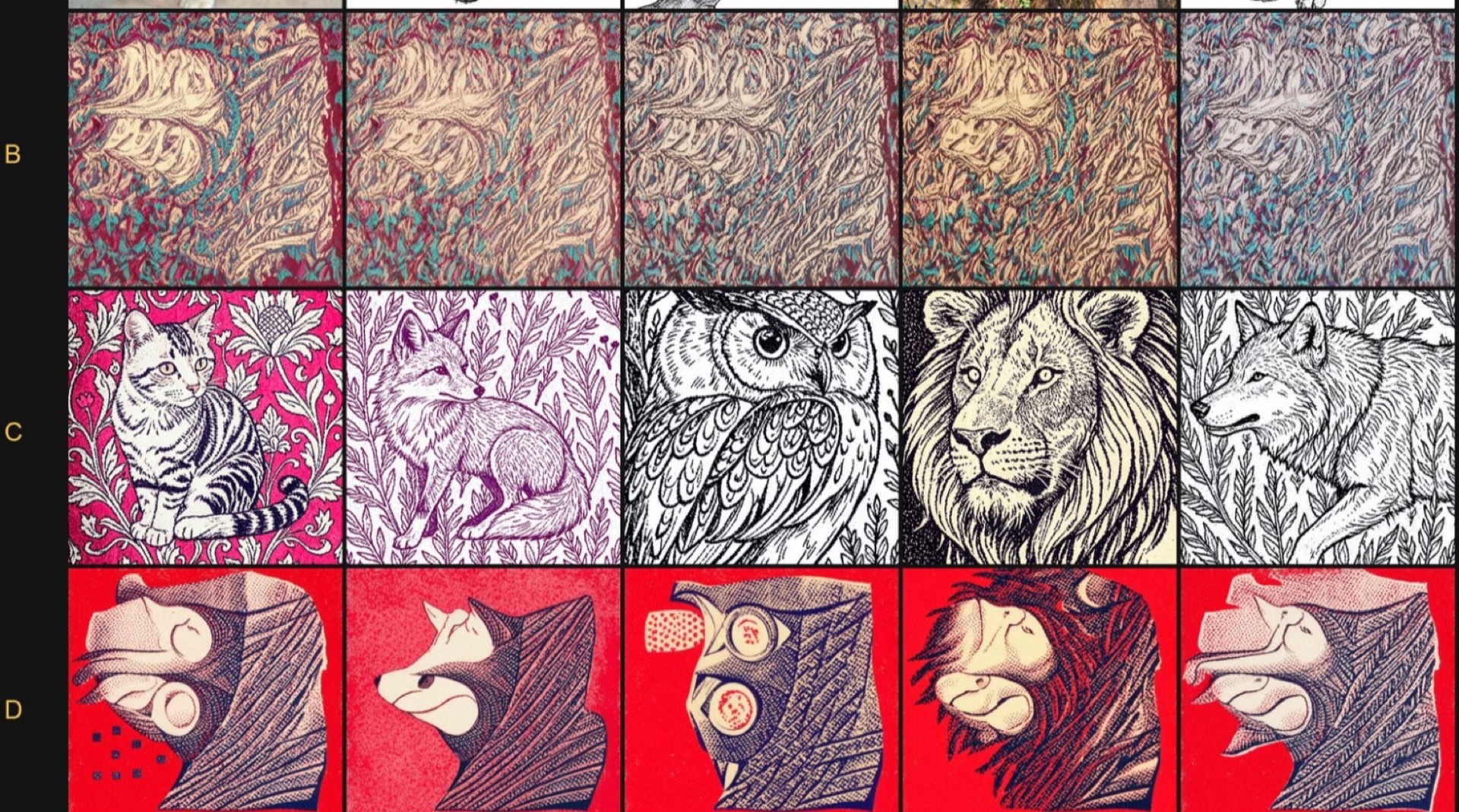
FLUX LoRA ablation: test the pipeline, not one pretty image
Ablation is useful when each comparison changes one variable while data, seed set, prompt suite and evaluation criteria remain fixed. For FLUX LoRA, separate subject fidelity, pose control, style, artifacts and overfitting. Report a result grid, settings, failures and reproducibility limits rather than a single best-looking image.
Key takeaways
- —One hypothesis gets one changed variable.
- —Blind review reduces configuration bias.
- —A best image does not replace the result distribution.
- —Dataset rights and provenance belong in the experiment.
Ablation starts with a hypothesis
State a testable question: does dataset composition, caption style, training schedule or a control adapter affect a specific criterion? Do not change model, data and post-processing together. A generative-content service turns research into a repeatable production flow where the result must survive a task series, not one selected frame.
Treat dataset and captions as versioned artifacts
Retain file inventory, rights, checksums, cleaning rules and caption version. Mark rare angles, backgrounds, clothing and elements the model should not reproduce. Without a versioned dataset, a rerun does not test the same hypothesis. The AI image workflow guide adds rights and visual QA to the experiment.
Ablation workflow
- Pin baseline, dataset, prompt suite and criteria.
- Change one variable and retain the configuration.
- Generate the same grid for every configuration.
- Hide configuration labels from reviewers.
- Score fidelity, control, artifacts and diversity separately.
- Repeat disputed results and publish failures.
Evaluate without cherry-picking
Define criteria and exclusion rules before reviewing results. Compare the same prompts and seeds, retain negative examples and show variation. LoRA reduces trainable parameters relative to full adaptation, but that does not guarantee quality for a particular dataset. Keep the conclusion bounded to the tested configuration.[1]
Aiconic evidence: full-cycle AI production
Limitations and failure modes
A small or homogeneous dataset creates false confidence, while overfitting can reproduce training examples. Other failures include changing multiple factors, reviewing with visible labels and hiding failed seeds. The AI production case shows why a research result must move into editorial control, rights review and a stable workflow.
Frequently asked questions
Can one benchmark support a decision?
No. One run or sample describes a specific configuration. A decision also needs repeatability, error analysis, quality and operating conditions.
Why is average accuracy insufficient?
An average can hide rare costly errors and condition differences. Break results down by use case and consequence.
When should a pilot stop?
Stop when data, rights, security, success criteria or a safe action after the result cannot be established.
Sources and evidence
- 1.LoRA training guide — Training and loading LoRA adapters.
- 2.LoRA: Low-Rank Adaptation of Large Language Models — Original research basis for low-rank adaptation.
- 3.FLUX official repository — Official framework, models and terms for FLUX.
- 4.The Machine Learning Reproducibility Checklist — Checklist for reproducible experiments and reporting.