Creating Songs with AI for Business
Creating songs with a neural network for business is not a push button path to a hit. It is a controlled pilot: define the use case, write a brief, generate drafts, review rights and provenance, edit with people, and decide whether the workflow fits brand, campaign, training, or content needs.
When a business should test AI songs
An AI song makes sense not as a novelty, but as part of a specific communication task. It may support a brand motif, a learning video, a campaign draft, or an internal event. The team should first define the listener, the placement, the desired tone, and the person accountable for final creative judgment.
The business value remains a hypothesis, not a promise. A pilot helps test whether the approach helps the team explore musical ideas, preserve brand style, and make decisions with less ambiguity. If the task depends on a recognizable artist, deep emotional arc, or exclusive composition, AI is better treated as a sketching tool rather than an independent author.
How to define the pilot boundary
The pilot boundary begins with the brief. It describes the track purpose, audience, acceptable genre references, banned associations, language, mood, duration as a creative intent rather than a hard metric, usage channels, and the human role in revision. The team should also define which inputs may be used and which are excluded because of rights, contracts, or reputation risk.
Acceptance criteria should be written before generation starts. The team agrees which signals make an output worth developing: fit with the brief, absence of unwanted references, clear source history, editability, technical cleanliness, and alignment with brand voice. If the criteria remain vague, discussion becomes a taste debate and does not support an implementation decision.
Workflow for creating a song with AI
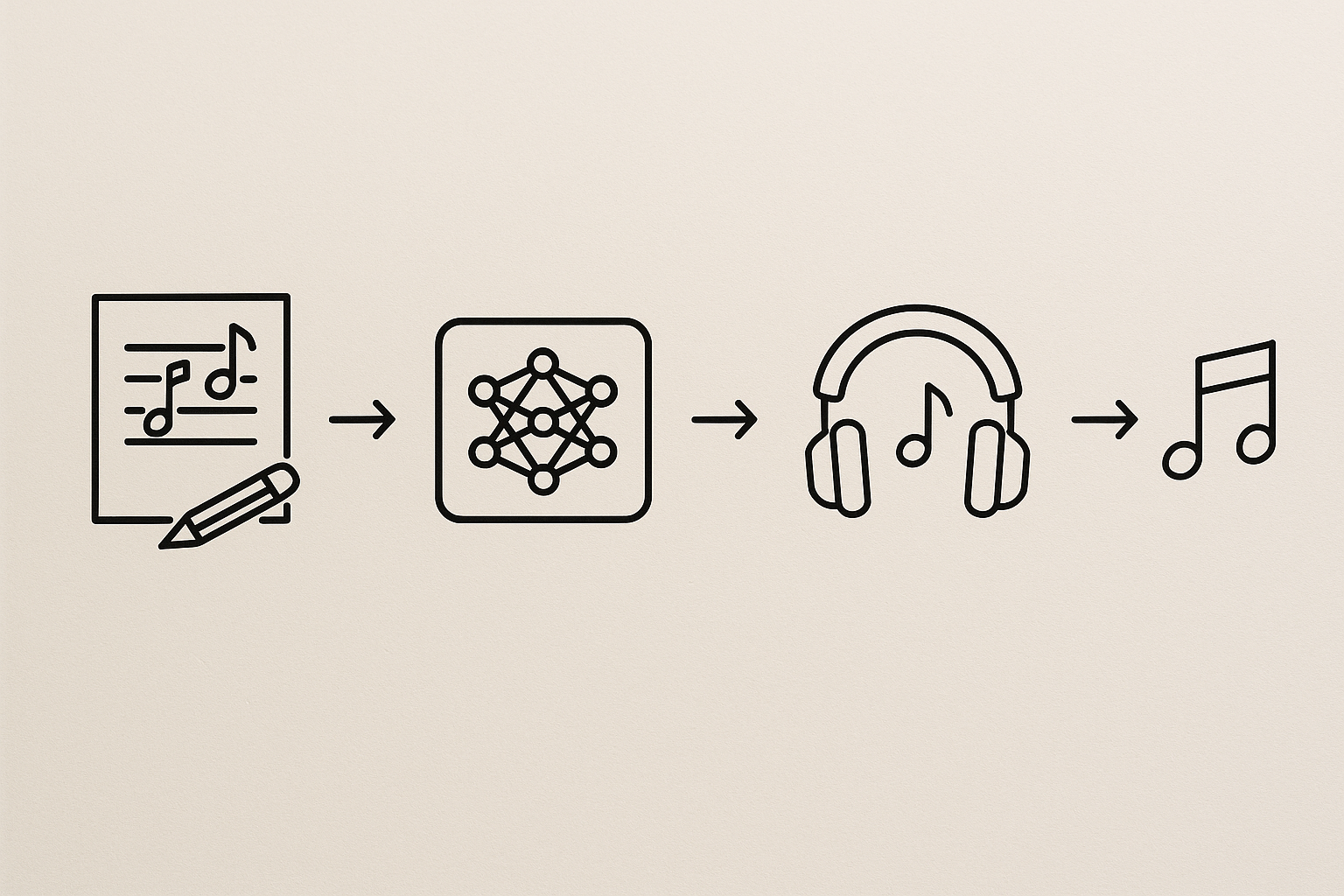
The workflow is built around drafts, not an instant final master. The team prepares a brief and safe source inputs, generates music or lyric options, selects promising directions, and passes them to an editor, producer, or brand team. AI can expand the range of options, but meaning, taste, legal caution, and publication judgment remain human responsibilities.
In practice, it is useful to keep a record of prompts, input materials, tool settings, selected takes, and manual edits. This process map helps explain how the output was produced, which elements were human made, which were generated by the model, and which checks were completed. That matters for repeatability, internal approval, and later legal review before public use.
- Define the task and audience
- Prepare a safe brief
- Generate drafts
- Select workable directions
- Edit lyrics and music with people
- Review rights and provenance
- Decide to launch or pause
Rights and provenance
Rights review starts before materials are uploaded into a tool. The team must understand whether it has permission to use melodies, references, voice recordings, lyrics, brand slogans, and archive audio. Even when a service makes generation easy, the business still needs a separate review of license terms, commercial use limits, AI disclosure rules, and platform requirements.
Provenance should be described as carefully as the creative brief. It is useful to preserve which materials were used as inputs, which generated elements were selected, and which edits were made by people. If provenance labeling or an internal register is used, it does not prove artistic value, but it helps an auditor, lawyer, and editor understand the creation chain.
Limitations and launch decision
Common failures are not only about sound quality. A model may produce a generic motif, lose the intended mood, drift toward a recognizable style, struggle with language, create awkward vocal imitation, or output material that is hard to edit. Sometimes the result feels pleasant as a demo but fails review against brand, rights, or use context.
The launch decision should be explicit. If the track passes creative, technical, and legal review, it can move into normal production with human responsibility for the final version. If doubts remain about provenance, style similarity, quality, or reputation risk, it is better to pause the pilot, change the brief, or return to traditional work with authors and producers.

Sources and evidence
- Music Transformer: Generating Music with Long-Term Structure — Supports the technical explanation of musical structure generation and shows that research systems include both demos and failure examples.
- MusicGen Model Card — Useful for sections on model purpose, limitations, risks, licenses, data, and the need for evaluation before applied use.
- AudioCraft Repository — Confirms the context of an open research library for audio generation and helps separate prototyping from a ready business process.
- Copyright and Artificial Intelligence — Provides official context for authorship, AI material, model training, and disclosure of generative tool involvement.
- Copyright Registration Guidance: Works Containing Material Generated by Artificial Intelligence — Supports the recommendation to document human contribution and separately account for AI generated parts during rights review.
- C2PA Technical Specification — Supports the approach to recording media provenance and explains why change history helps trust review.