AI Agents for Business: A Practical Guide
AI agents for business are software systems that receive a goal, plan steps, use approved tools and perform part of a workflow under human control. A practical rollout starts by choosing a measurable process, defining data and permission limits, logging actions, running a baseline pilot and scaling only after error and risk review.
What an AI agent means in a business context
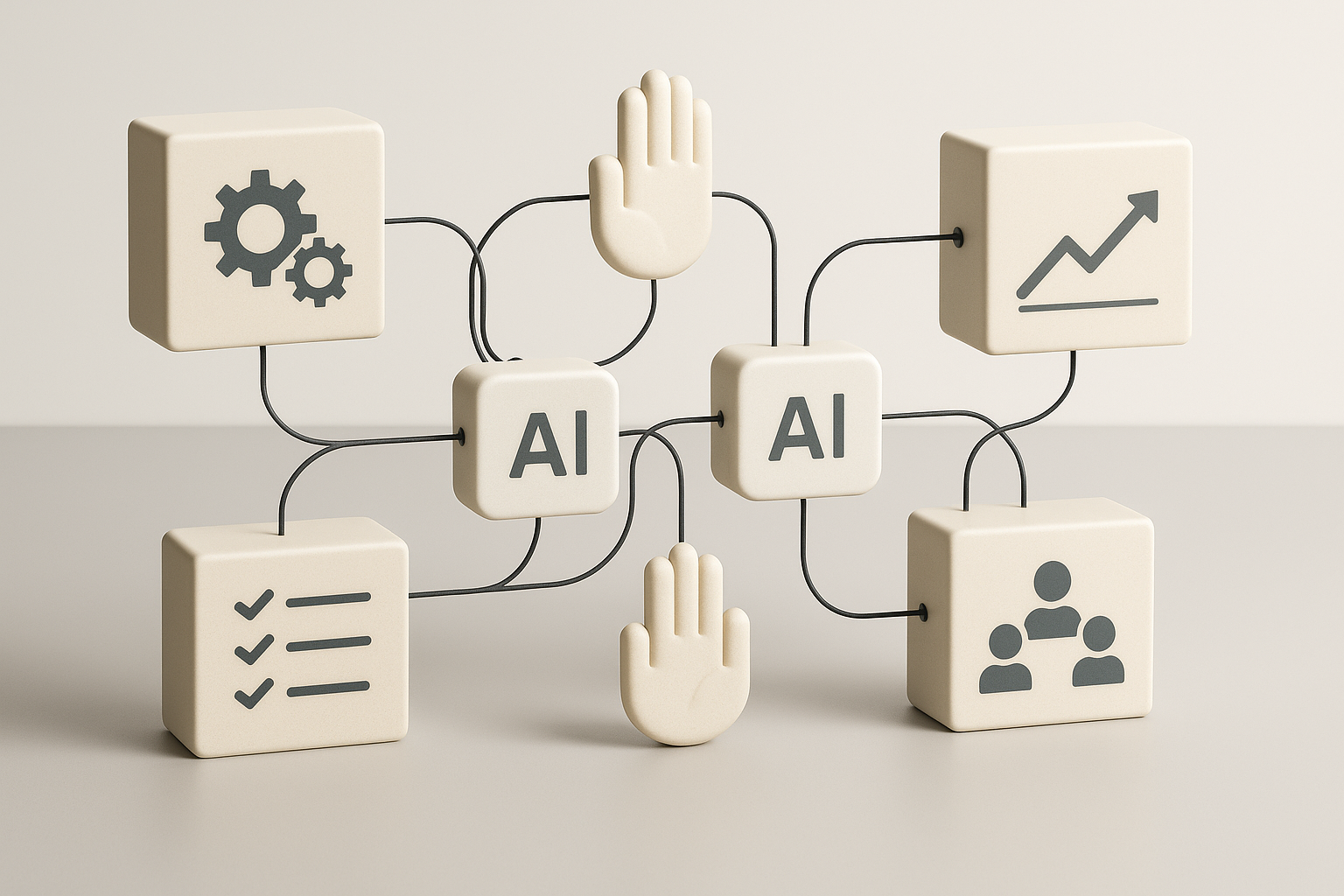
In business, an AI agent differs from a chatbot because it does more than answer in a conversation: it operates inside a process, receives a goal, chooses next steps, calls tools and returns a result that can be checked. In a governed architecture, agency does not mean full autonomy. The scope is constrained in advance by task, data, permissions, stopping rules and human handoff points.
In practice, an agent loop usually combines a language model, company context, approved tools, logs and escalation rules. The starting point should not be the strongest model, but a process with repeatable inputs, a clear owner, an observable outcome and a baseline for comparison. Expected value should be written as a hypothesis to test, not as a promised result.
Where agents fit, and where ordinary AI is enough
An AI agent fits tasks that require several connected decisions: gather data, check constraints, prepare a draft, create a task, notify an owner and leave an audit trail in a system. Common B2B areas include first-line support, sales, partner operations, meeting analysis, legal and finance workflows, standards control and market intelligence. In each case, the agent needs a narrow perimeter, not access to the whole business.
If the task is only classification, knowledge-base answering or draft creation, a full agent may be excessive. Retrieval, a template, human review and a normal workflow with clear rules are often enough. The decision should follow a process map: which inputs arrive, which decisions are made, where a system write is needed and where an error creates commercial, operational or legal risk.
Implementation workflow: from task map to pilot
The workflow starts by choosing a process and describing the current scenario. The team records inputs, exceptions, data owners, manual checks and actions the agent is allowed or forbidden to take. It then designs the smallest viable loop: what knowledge the agent reads, which tools it calls, what data it writes, when it must stop and how the user will understand what happened.
In the pilot, define the baseline, metrics and stop criteria before launch. Metrics may include classification quality, completeness of filled fields, escalation share, user complaints, time to human handoff and cost per completed scenario. Scaling is justified only after error review, log inspection, access tuning and explicit responsibility alignment between the process owner, IT, security and the legal function.
- Choose a repeatable process with an owner and measurable outcome.
- Describe data, tools, permissions, exceptions and human control points.
- Build a minimal agent loop with logging and constrained actions.
- Run the pilot on a safe volume of real or de-identified tasks.
- Compare results with the baseline and classify errors by cause.
- Expand scope only after access, monitoring and accountability are tuned.
Governance, security and data
An agent has more capability than a plain model because it can read context, choose a tool and initiate an action. Governance therefore has to cover the whole lifecycle: purpose, allowed data, roles, logging, testing, monitoring and shutdown. For business scenarios, it is useful to separate policy from the prompt: critical restrictions and checks should be enforced by code, access rights and external systems.
Particular attention should go to untrusted instructions and tool permissions. Input from an email, website, document or CRM record can contain text that changes model behavior. If the agent also has broad access and write permissions, an error becomes an operational incident. The practical minimum is least privilege, output validation, action logs, human approval for significant operations and regular testing of rule-bypass scenarios.
Limitations and common failure modes
An AI agent can be confidently wrong, choose the wrong tool, miss context, loop or take an action that is formally allowed but contradicts the process logic. Some failures come not from the model, but from weak tool descriptions, outdated knowledge bases, ambiguous permissions or processes where employees already follow different rules. An agent does not repair chaos; it makes chaos visible.
Before scaling, acknowledge the boundaries: an agent does not replace the process owner, lawyer, accountant, security team or quality manager. It can handle verifiable operations inside an agreed perimeter, but decisions with high downside should remain under human control. If the pilot is unstable, the better move is to narrow the task, improve data or return to a simpler workflow, rather than increase autonomy.

Sources and evidence
- AI Risk Management Framework — Supports the lifecycle-based approach to AI risk management and the voluntary nature of the framework.
- AI RMF Core — Provides the govern, map, measure and manage structure and emphasizes continuous risk management.
- Artificial Intelligence Risk Management Framework: Generative Artificial Intelligence Profile — Describes generative AI risks and suggested actions for managing them in business processes.
- Building Effective AI Agents — Supports the distinction between workflows and agents, and the principle of minimum sufficient complexity.
- 2025 Top 10 Risk & Mitigations for LLMs and Gen AI Apps — Lists current risk categories for LLM and generative AI applications.
- LLM01:2025 Prompt Injection — Supports recommendations for handling direct and indirect untrusted instructions.